


Japan and the United States have agreed to cooperate on next-generation nuclear power reactors and rare earths, as Tokyo seeks to re-enter the nuclear technology export market and both seek to reduce China's dominance of key electronic components.
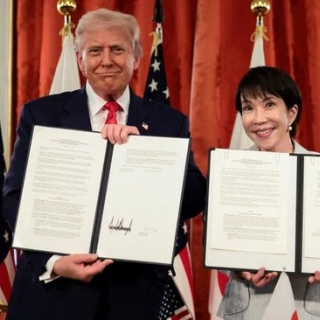
US President Donald Trump and Japanese Prime Minister Sanae Takaichi signed a framework agreement on Tuesday to secure supplies of rare earths, used in everything from cars to fighter jets.
They signed the documents, covering critical minerals, at Tokyo's neo-Baroque Akasaka Palace, beneath three ornate gold chandeliers, to thunderous applause from aides.
They did not directly mention China, which processes more than 90% of the world's rare earths, making it a source of concern for each country's mineral supply chain. Beijing recently expanded export restrictions.
Trump and Chinese President Xi Jinping are scheduled to meet on Thursday on the sidelines of the Asia-Pacific Economic Cooperation in South Korea to discuss a deal that would halt higher US tariffs and controls on Chinese rare earth exports.
Japan and the United States will use coordinated economic and investment policy tools to accelerate "the development of diversified, liquid, and equitable markets for critical minerals and rare earths," the White House said in a statement.
They aim to provide financial support to selected projects within the next six months, it added. The two countries will consider complementary stockpiling arrangements and work with international partners to ensure supply chain security, it said.
While China dominates global rare earth extraction, the United States and Myanmar account for 12% and 8%, respectively, according to Eurasia Group, while Malaysia and Vietnam account for processing—where China is also a top player—at 4% and 1%, respectively. (alg)
Source: Reuters
The upcoming Supreme Court ruling on the legality of President Donald Trump's massive tariffs, which rocked markets in April, is one of the next major tests for US stocks and bonds. Equity markets ha...
The US seized two Venezuela-linked oil tankers in the Atlantic Ocean on Wednesday, one of which was sailing under a Russian flag, as part of President Donald Trump's aggressive efforts to regulate oil...
France is working with partners on a plan on how to respond should the United States act on its threat to take over Greenland, a minister said on Wednesday, as Europe sought to address U.S. President ...
The world community must make clear that U.S. intervention in Venezuela is a violation of international law that makes the world less safe, the Office of the United Nations High Commissioner for Human...
US President Donald Trump threatened on Friday to come to the aid of protesters in Iran if security forces open fire on them, days after unrest that has killed several people and posed the biggest int...
Oil prices stabilized on Thursday (February 12th), as the market reassigned a risk premium to US-Iran tensions despite US inventory data showing swelling domestic supplies. This movement confirms one thing: geopolitical headlines are still more...
Gold prices weakened slightly on Thursday (February 12th), as more solid US employment data reduced market confidence in an imminent Federal Reserve interest rate cut. The strong employment data prompted market participants to shift expectations of...
The Hang Seng Index reversed its downward trend in Hong Kong on Thursday (February 12th), weakening by around 0.9% to around 27,000 after a strong session earlier. This decline halted the momentum of the short term rally, as investors began to...